

Nissan Battery Group Size and Replacement Guide in Slinger, WI
Russ Darrow Nissan of West Bend – Nissan Battery Group Size and Replacement Guide in Slinger, WI
When a 12-volt battery fails, it almost never picks a convenient time. If you’re in Slinger, WI and your Nissan is slow to crank, flashing random warnings, or losing presets, the most likely culprit is a weak battery—or the wrong battery spec for your trim. This guide explains group sizes, technology types, and installation steps so you can choose the right replacement and avoid electrical headaches afterward.
What battery “group size” really means
Group size isn’t just a shape code—it determines physical dimensions, terminal layout, and fitment for your battery tray and cables. Common Nissan sizes include Group 35 (frequent in Sentra, Altima, and Rogue applications), 24F (some SUVs and trucks), 47/H5 or 48/H6 (select late-models), and others depending on year and package. Equally important are cold cranking amps (CCA) and reserve capacity (RC). Going below Nissan’s specification can degrade cold starts, voltage stability, and accessory performance; going too high without the right technology (like AGM or EFB) can be an expensive mismatch that doesn’t deliver added value.
Modern Nissans equipped with idle stop-start often require Enhanced Flooded (EFB) or Absorbed Glass Mat (AGM) batteries to handle frequent restarts and deeper cycling. Traditional “flooded” batteries are fine for many trims without stop-start, but they’re not designed for repeated high-cycle demands. If you’re unsure what’s installed—or what should be—bring your VIN; we’ll pull the exact spec and recommend the correct technology.
Choosing the best battery for how you drive
Everyday Slinger trips to Hartford, Jackson, or West Bend can be short and accessory-heavy—heated seats, lights, and audio—without enough sustained charging time. The right CCA and RC help your alternator keep up. If your Rogue, Sentra, or Frontier has additional accessories (light bars, winch, upgraded audio), we’ll factor those loads into the recommendation, ensuring cables clear the hood and terminals align with your tray. Some late-model Nissans also benefit from battery registration or vehicle resets after installation to maintain accurate charging logic.
- Group size check: Verify fitment, terminal orientation, and hold-down compatibility by VIN.
- Technology type: Match flooded, EFB, or AGM to your vehicle’s charging strategy and stop-start needs.
- Performance spec: Meet or exceed CCA and reserve capacity noted in Nissan specs.
- Accessory load: Account for added draw from lighting, audio, or winter gear.
- Install procedure: Use memory-saver tools and perform any needed post-install resets.
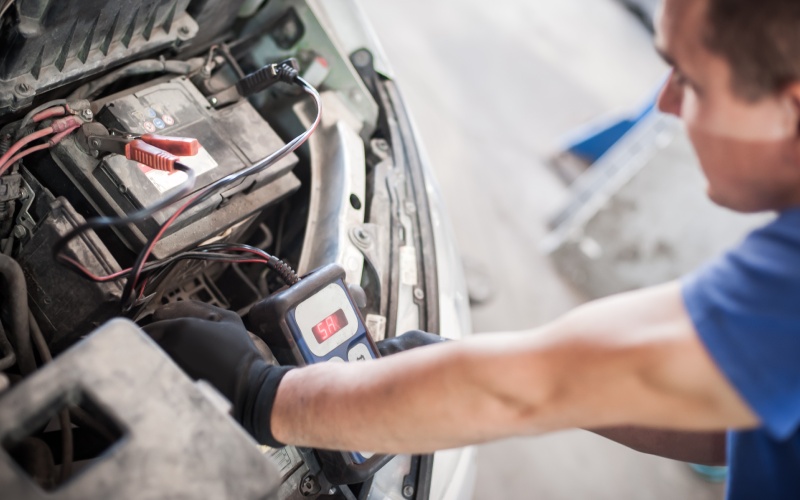
DIYing the job? A memory-saver can preserve radio presets and window indexes. Always detach the negative terminal first and reconnect it last. After installation, confirm your clock, auto-up/down window calibration, and steering angle initialization—some models require a short drive cycle to clear transient warnings. If a battery management reset is needed, we can handle that quickly in our service lane.
Symptoms that suggest your battery—not something else—is to blame
Sluggish cranking, multiple warning lights at startup, dim interior lighting, or an intermittent “click” under the hood point to low voltage. Keep in mind, a weak battery can also create false positives in other systems, making diagnostics confusing. We test state-of-health, state-of-charge, and conductance under load so you know whether a recharge, replacement, or alternator check is appropriate.
For EV drivers—yes, you still have a 12-volt battery. A Nissan LEAF’s high-voltage pack powers the drivetrain, but the 12-volt battery runs accessories, control modules, and relays. If that auxiliary battery weakens, you may see a dash full of warnings or a no-ready condition. We stock the correct 12-volt options and verify software status after installation.
Local fitment help and professional install
Battery trays and tie-down points differ across years and trims. We confirm physical fit, terminal orientation, and cable reach before installation, then secure the hold-down to factory torque so vibration doesn’t shorten battery life. If your vehicle needs idle-stop calibration or charge-adaptation, we complete those steps and perform a systems check to make sure windows auto-index correctly and warning lights remain off after a short road test.
If you split time between Slinger and commutes near Menomonee Falls, WI, short-hop driving can undercharge a battery over weeks. A smart trickle charger used periodically at home can help, and we’re happy to point you toward a maintainer compatible with your model. For fleet or multi-vehicle families, we can align group sizes and technologies across vehicles where practical to simplify maintenance.
When you’re ready to order, bring your VIN or snap a photo of the existing battery’s label. We’ll confirm exact group size, CCA, and technology type, then set aside the right unit—complete with any vents, adapters, or hold-down hardware needed for a clean install. Our OEM parts come backed by a 2-year warranty on eligible components, and installation can be scheduled through our service team for same-day convenience when possible.
Prefer a quick, over-the-counter swap? Our counter staff will show you safe lift points, terminal order, and torque guidance. Want it handled for you? We’ll install, test charging output, and perform any necessary vehicle resets. You’ll leave with solid cranking power, stable voltage for accessories, and peace of mind for morning starts—whether you’re headed to school drop-off, Pike Lake, or errands across Washington County.
Frequently Asked Questions:
How do I find my Nissan’s battery group size?
Check your owner’s manual, existing battery label, or bring us your VIN. We’ll verify exact size, terminal layout, and technology requirements before you buy.
Do I need AGM or EFB if my car has stop-start?
Yes—most stop-start systems require EFB or AGM for durability under frequent restarts. We’ll confirm by VIN and recommend the correct technology for your trim.
Will a larger CCA always be better?
Not always. You should meet or exceed Nissan’s spec, but pairing higher CCA with the wrong technology can be counterproductive. We’ll balance CCA with the right battery type and physical fit.
Can you install and register my new battery?
Absolutely. We use memory-saver tools, perform any needed resets or registrations, test charging output, and confirm that warning lights remain off after a drive cycle.
Do you serve nearby communities?
Yes. While this guide focuses on Slinger, we regularly support drivers across Washington and Waukesha County, including those near Menomonee Falls, WI.
Whether you’re picking up a battery at the counter or scheduling installation, our team at Russ Darrow Nissan of West Bend is ready to help you choose confidently and get back on the road quickly. Bring your VIN, and we’ll handle the rest—from technology selection to safe, professional installation that preserves vehicle settings and module health.
0 comment(s) so far on Nissan Battery Group Size and Replacement Guide in Slinger, WI